Showing posts with label israel. Show all posts

06 January 2009

Pro-Palestine Protest in Paris

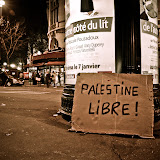
Last Saturday there was a sizable (twenty to twenty-five thousand people according to various counts) protest in support of Palestine and, often, against Israel. Esther and I decided to go to see what there was to see. Thankfully I brought my camera as the situation, tense throughout, degraded considerably at the end.

The march started at Place de la République and progressed down the Grands Boulevards to Place St. Augustin.


This was a surprising route for any protest march as it passes directly in front of the "Grands Magasins", major banks, and plenty of very expensive real estate. Normally, protests (of which there are many) are routed towards more modest districts.

The anger towards Israel was evident in the crowd.

The chant "Israel, Assassin!" was popular, as was the swastika/Star of David equivalence.

Protesters carried pictures of dead and injured Palestinian children and adults, as well as at least one mock dead child.


I was surprised to see several Hezbollah flags on display. Paris has a large Lebanese population and apparently a certain number of supporters of the paramilitary organization.

The advertisement in the background for the Tribune Juive (Jewish Tribune, a magazine for the French Jewish commonity) featured Carla Bruni, the wife of President Sarkozy, and was not particularly popular with the protesters.

Further down the route, slogans began to be spray-painted on many different surfaces.


There was an interesting conflation of causes as the flag of Hezbollah (literally, "the party of God") came into close proximity with the flag and secretary general of the PCF (Parti Communiste Français, not exactly the party of God).


As we got closer to the Grands Magasins and some larger bank branches, the police presence visibly increased.


Eventually we arrived at Place St. Augustin, the scheduled end of the march.


A young man carried the flag of Hamas as others prayed. Things started off rather peacefully.


Unfortunately, trouble-makers in the crowd had other ideas for how to end things. They started by climbing scaffolding attached to a building.


This led to tear gas.


Which, in turn, led to fire set by the protesters.


Smoke rose over the square.


Riot police began to advance, passing in front of the Saint Augustine Church, confining the protesters and forcing them out of the square.


We learned that the fuel for the fire was the French classic: a car that had the bad luck of being parked in the wrong place at the wrong time.


More police arrived in full riot gear. They needed to clear the area to allow the firefighters to arrive safely.


Ultimately the firefighters made it through...


...though it was a bit late for the car.


Meanwhile, other cars were overturned and burned.


The square was left strewn with banners and ashes.


Full album:
Palestine Protest in Paris

10 October 2008

Negev

The Negev Desert stretches southeast from Kibbutz Nirim, all the way to the port city of Eilat on the Red Sea. Altogether, it accounts for more than half of Israel's land area, but only a tiny fraction of its population. It's full of interesting geological features including countless wadis as well as the unique makhtesh (often referred to as "craters", they are technically "erosion cirques".) Roni was kind enough to take us on a tour of the area in one of the kibbutz's silver Subaru Imprezas. There were many impressive sights, not the least of which were the Merkava main battle tanks doing training exercises along the side of the road.

Travels - Israel - Negev

09 October 2008

Kibbutz Nirim

In the south, we stayed with Roni, the brother of Esti (a distant relation but extremely close friend of Esther's family), in his kibbutz, Nirim. Nirim is a more traditional kibbutz, maintaining more collective ownership and activities than Yehiam in the north. A small but important example of this is the fact that the communal dining hall still serves several meals a day, though you now have to pay a nominal fee to eat there.

What is perhaps most striking about Nirim, however, is its proximity to the Gaza Strip and the security implications that that has on life in the kibbutz. At only two kilometers (just over one mile, you could walk the distance in less than 30 minutes), you can see the low skyline of the strip. The kibbutz is surrounded by concertina wire and has strong metal gates that remain closed all day long. In addition to the entrances to the underground shelters, there are also above-ground emergency shelters every hundred yards or so, should you ever hear incoming rockets. The kibbutz is typically not targeted for rocket attacks, however, as they are generally aimed at the larger town of Sderot.

Walking in the fields surrounding the kibbutz, outside of the perimeter fence, you have the impression that you are in a perfectly bucolic setting. Not even over the horizon, however, is the Gaza Strip and its choking population density, desperate economic conditions, and unstable political situation. Once again, Israel shows itself to be a land divided, a contradiction in the most complete sense.

Travels - Israel - Kibbutz Nirim

08 October 2008

Haifa

We were only in Haifa for a few hours, just enough time to see the Bahá'í World Center, return our rental car, and take a train to the south. It certainly seemed pleasant and it's distinction of being the most demographically-balanced large city in Israel was plainly visible. It's a very short photo album, consisting of a few photos that I took on the top of Mt. Carmel. (By the way, if you're not familiar with the Bahá'í Faith, it's worth looking at its Wikipedia entry. If you're going to believe in an organized religion, you would be hard pressed to find one based on more appealing principles.)

Travels - Israel - Haifa

07 October 2008

Jerusalem

My original post, Juxtaposition in Jerusalem, captures the immediate sensation of the city much better than my rapidly fading recollections ever could. To those written words, I simply add the photo album below.

Travels - Israel - Jerusalem

06 October 2008

Golan

The Golan Heights are a mountainous plateau in northern Israel with both strategic military and natural resource value, leading to the area being claimed by Israel, Syria, and Lebanon. Controlled by Israel since the Six-Day War in 1967, they will likely be returned to Syria as part of the negotiations leading to a peace treaty.

Oded, Yona, and Maya took us on the tour of the region and it was indeed impressive, not only for it's physical beauty, but for it's importance in the history of countless empires and regimes. Nimrod Fortress is a good example. Built by the nephew of the Sultan of Egypt and Syria, Saladin, in the twelfth century, it was designed to defend Damascus from the crusaders. It served as one link in a chain of hill-top fortress, each visible to the other by sight, to protect Syria from the invading Europeans.

Naturally, over time, it passed from one empire to the next, serving various functions including luxury prison and, today, tourist attraction. It is relatively well preserved and features some impressive construction for its time and its remote location.

The Golan is full of interesting locations, from Alawite and Druze villages, to hidden waterfalls, and including rusting armored vehicles on the side of the road. It is a rough land, its surfaced pockmarked by centuries of battle and it maintains the sense that its status is still far from finalized.

Travels - Israel - Golan

05 October 2008

Sea of Galilee

The Sea of Galilee is Israel's largest body of freshwater and, from the perspective of a Michigander, it's only freshwater of note. Back in the day it was, of course, the site of Jesus' miraculous, low-speed water skiing while today it is the site of regular-old, physics-driven water skiing. The one large city on it's banks, Tiberias, is a very popular tourist destination in the north, drawing a larger-than-average proportion of wealthy religious families. The one experience that sticks with me from this town is melting in the 100-plus degree heat while waiting to get a falafel. Inside of the sandwich shop, the open grills easily raised the temperature to a smoky, greasy 120 degrees. Esther was bravely waiting in this line as tempers gradually mounted until a portly, young, religious man stormed in and demanded to be served before everyone else because he, HE!, couldn't stand the heat. It wasn't a particularly welcoming situation; people were self-centered and impatient and it didn't give me the desire to go back.

On a seperate trip, however, we went to a much more peaceful area, the site of Capernaum, Jesus' hometown when he lived there. Today, there are several monasteries on the site which is calm and peaceful, a considerable contrast to the modern-day insanity of Tiberias.

Almost all of the pictures are from Capernaum, I simply didn't have it in me to take pictures of sweaty, rude, rich people at Tiberias.

Travels - Israel - Sea of Galilee

03 October 2008

Nazareth

Nazareth, home of Jesus of, is now a sizable Arab city that draws off of its history. The streets were full of tourists wearing funny hats, including some German guys of high school age wearing white mesh hats with a solar powered fan built into the brim and directed at their faces. You get the impression that the tour buses pass through everyday, drop off their human cargo for an afternoon, before continuing on to another site of historical importance; all of this while the residents calmly look on. Admittedly, this is precisely what we did.

We made an effort to find Mount Precipice and were told by the security guard at a strip mall that we had to cut through a fence and then hike up a trash-strewn slope to get to the small chapel at the top. Standing up there, looking at what could have easily been a strip-mall in Rochester (complete with Office Depot and Ace Hardware!) on one side, the modern Arab town on the other, and the ancient chapel straight before us did make for a moment of strong cognitive dissonance though one that is representative of Israel as a whole.

Travels - Israel - Nazareth

25 September 2008

Rosh Hanikra

At the northwest extreme of Israel, there is a unique formation of brilliantly white, exceptionally soft chalk jutting into the pure blue waters of the Mediterranean called Rosh Hanikra (the Head of the Grottoes). During the British Mandate, a train tunnel was cut through the rock, one step in the British Empire's goal to connect Cairo with Istanbul and, from there, Europe.

On top of the rocks is the border crossing with Lebanon that is operated by the UN. You can walk right up to the gate and, like good tourists, we did. It was quiet and calm, though I imagine that wasn't the case two years ago.

Travels - Israel - Rosh Hanikra

The Beach

The northern Israeli Mediterranean beach is absolutely fantastic. The water is warm, the sand is clean, and the ever-present waves prevent swimming from ever becoming dull. Laying on the beach, watching the sunset with a cold bottle of Goldstar is really a wonderfully pleasant experience. The climate, falling into the upper seventies as the sun goes down is, of course, the perfect compliment. It's happy, peaceful place, though the passing patrol boat reminds you that you're never that removed from the rest of the world.

Travels - Israel - Beach

Acre

Acre, like many cities in the region, has been in the hands of various empires and kingdoms. In 1799, under Ottoman rule, it held off a two month siege by Napoleon's troops in his efforts to weaken Turkey.

Today, it is a predominantly Arab city and, as such, has a unique flavor to it. The streets are narrow; the market is crowded, noisy, and in some places, pungent; and the hummus is really delicious.

It appears to derive much of its economy from the tourism that its various historical sites attract. Esther and I were there only for a few hours with Yona before heading to the beach.

Travel - Israel - Acre

23 September 2008

Kibbutz Yehiam

Before I can talk about Yehiam and what makes it unique, a brief discussion of kibbutzes in general seems necessary.

Kibbutzes (kibbutzim following Hebrew plural rules) are, typically, agricultural communities organized around deeply socialist principles. In their most traditional form there is no private property, even clothing is shared among the members. These communities were vital to the development of the country of Israel, allowing the population to rapidly settle the desert, converting much of it to arable land.

This traditional model is extremely rare today and most kibbutzim have undergone some degree of privatization. In its weaker forms, members now own their own clothes and personal possessions, but all of the land, buildings, and vehicles are communally owned. It is not uncommon that all salaries that are earned outside of the kibbutz are given to the community under the principle of "give what you can, receive what you need."

In other cases, privatization has gone much further with members owning their houses, their cars, and keeping a certain portion of their salaries. Yehiam falls into this later category. The transition to this weaker model was not entirely voluntary; it was largely motivated by the poor management and near insolvency of its center of economic production, a factory processing poultry into deli meats.

Naturally, there are a variety of opinions about the future of the kibbutzim and under what model they should be organized. Experience has shown that, unsurprisingly, the communities function very well under the traditional model when the members are there voluntarily and don't feel that they were born into a system that doesn't represent their values. Thus, the first generation of kibbutzniks were exceptionally motivated, the second generation somewhat less so, and the third generation much less. In some cases where a family has moved off of the kibbutz for some years or even a generation, the younger members will move back with the motivation of the original members.

Yehiam is unique in that it is the site of a fortress built originally by the crusaders and used by various empires and governments up to and including the War of Independence of 1948. In that war, the kibbutz was an important rally point for the convoy that supplied the north of the country. This convoy was ambushed with only a few members escaping to the kibbutz; there is a memorial to those lost made of the mangled armored vehicles.

It is the kibbutz that Esther's family is most closely connected to being the current residence of her aunt, uncle, and cousins as well as the previous residence of her father. We spent nearly half of our time at the kibbutz and it was indeed a peaceful time. The landscape is gorgeous, the air is clean and clear, and life inside the kibbutz is quite tranquil. The security situation is never far from view, however. One evening I wondered why the street lights pointed to the exterior of the chain link fence surrounding the kibbutz. I realized that it's because they aren't street lights at all, but perimeter lights.

Travels - Israel - Kibbutz Yechiam

21 September 2008

Tel Aviv

We stayed in and around Tel Aviv several times, it was our point of arrival and departure, as well as our base for our trips to Jerusalem. It is the de facto capital of the country and is clearly its economic and cultural hub. Eating dinner one night in a pan-Asian restaurant, we could have easily been in Miami or Berlin, if it weren't for ever-present political situation (quite a euphemism, no?).

More than anywhere else in Israel, however, a certain distance is taken from the problems, lending to them impression that you're removed from it all, almost like you're living in a bubble. At fourteen miles from the West Bank, thirty-five miles from Gaza, and seventy-five miles from Lebanon the impression is quite thin indeed.

Combined, the cities of Tel Aviv and Jerusalem provide a concentrated experience of the contradictions and contrasts inherent to Israel. If you had only two days in the country and you spent one in each city you would leave with quite a good understanding of the country (as best as one can have after only 48 hours, of course).

We stayed two nights in the apartment of Esther's cousin, Yona. Admittedly, drinking coffee on his large balcony in the warm morning air does give you the desire to settle in the city more permanently. The surrounding circumstances return quickly, however, to remind you that the skin of the bubble is indeed fragile.

Travels - Israel - Tel Aviv

Jaffa

Jaffa is the ancient port city just south of Tel Aviv. According to tradition, it is the port from which Jonas set sail on his journey that landed him in the belly of the whale.

Today it is still a port, though of much less importance than before. Compared to the metropolitan Tel Aviv, it has the feel of a forgotten backwater. Whereas the population of Tel Aviv is predominantly Jewish, that of Jaffa is mainly Arab giving it a very different feel. Rather than feeling like you're at the intersection of Los Angeles and Madrid as you might in Tel Aviv, in Jaffa you feel very much like you're in Amman or Cairo. In general, I got the impression that Tel Avivites rarely visit their southern neighbor.

It was the first town that we visited after arriving and is thus the beginning of this retrospective.

(Following its recent redesign, PicasaWeb no longer offers the static gallery links as before, the only option now are these slideshows. Fell free to watch them here, though I would suggest clicking on anywhere but the play button to go to the PicasaWeb site itself. You will see much larger images there as well as my captions.)The old option is back! I'm replacing all of the albums now.

Travels - Israel - Jaffa